Integrationsoption Ebene 02 · System

Geben Sie Ihrem Kühlraum einen steuerbaren Kältepuffer.

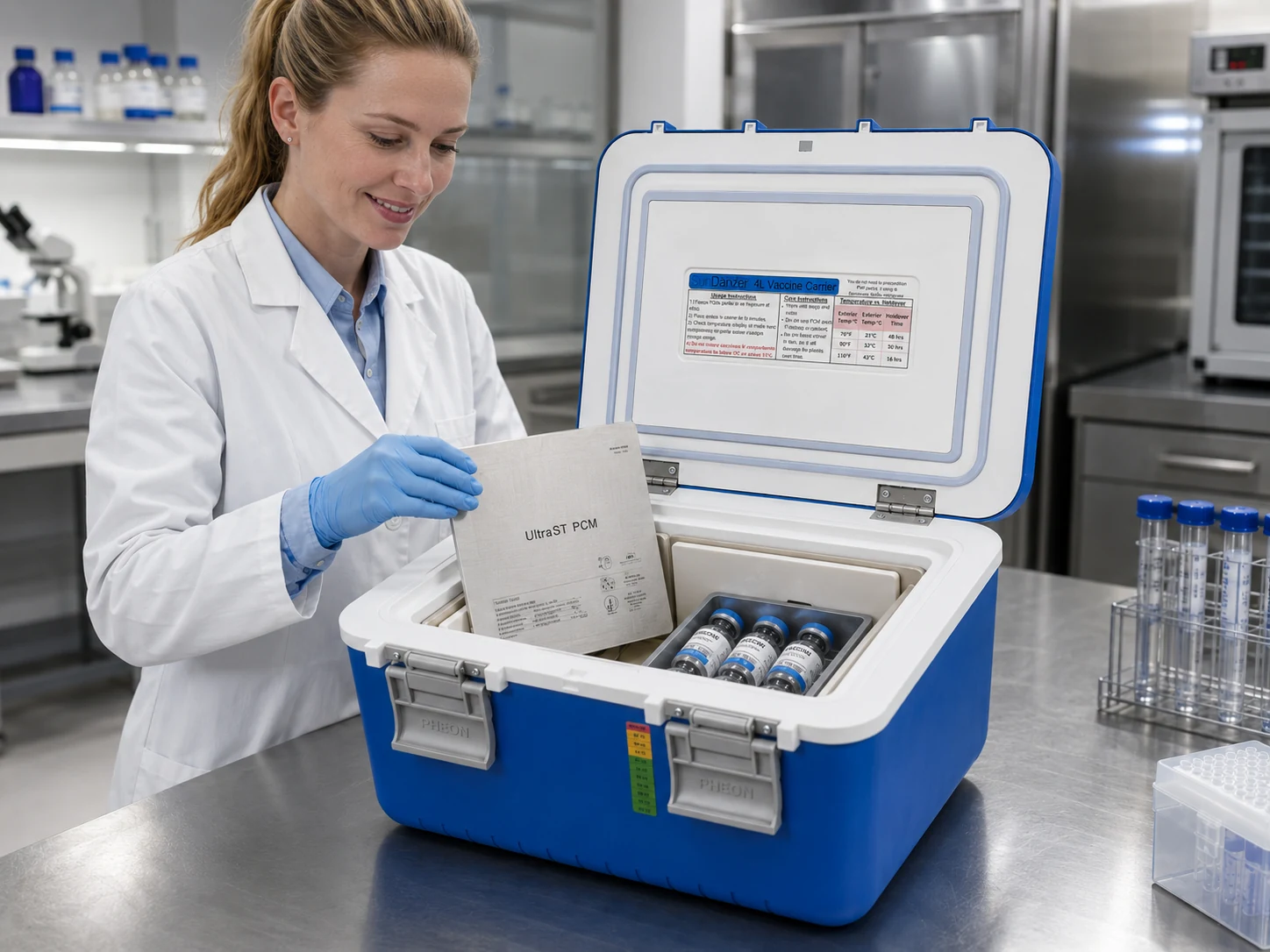
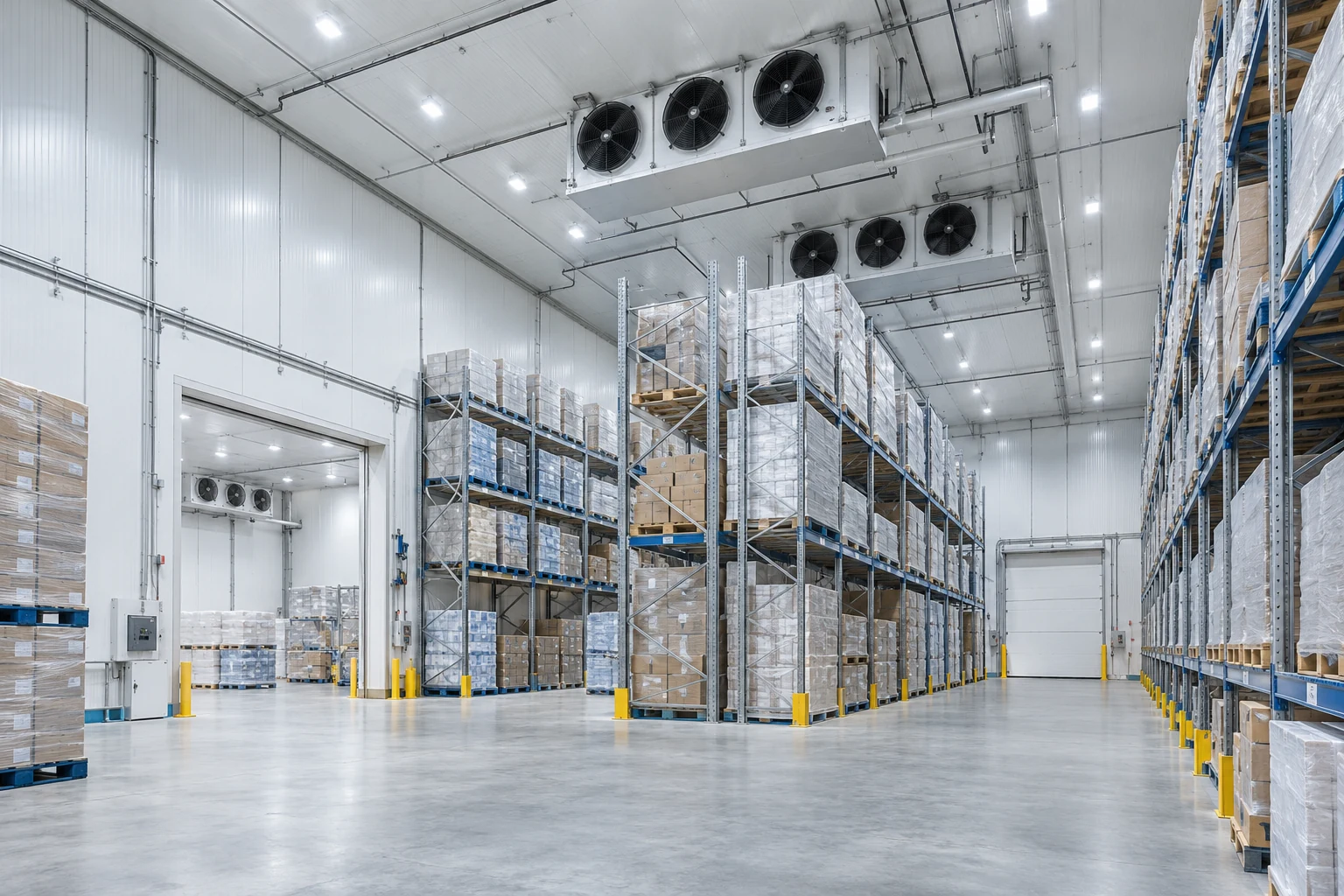
UltraST PCM thermal-storage solutions for food cold chain logistics and industrial cold rooms — charging cold during off-peak or PV-surplus windows, then releasing it during peak tariffs, door-opening spikes, and outage events to extend hold time, reduce compressor cycling, and lower retrofit complexity.

With Passive Edge UltraST PCM at the material core, downstream partner Solar Tribe integrates it into SolarCool Kit. Equipment patents, manufacturing, and system delivery belong to Solar Tribe.

Kernnutzen
Ausfallüberbrueckung · Peak Shifting · weniger Zyklen
Betriebslogik
Laden · Speichern · bedarfsgerecht freisetzen
Integrationspfad
Materialpaket · PCM-Platten · SolarCool Kit
Umsetzungspfad
Auslegung · Pilotkühlraum · Portfolio-Validierung
— Featured partner product · EDGE Material Inside · by Solar Tribe

SolarCool Kit — upgrading traditional ice boxes into a controllable PCM cold battery.

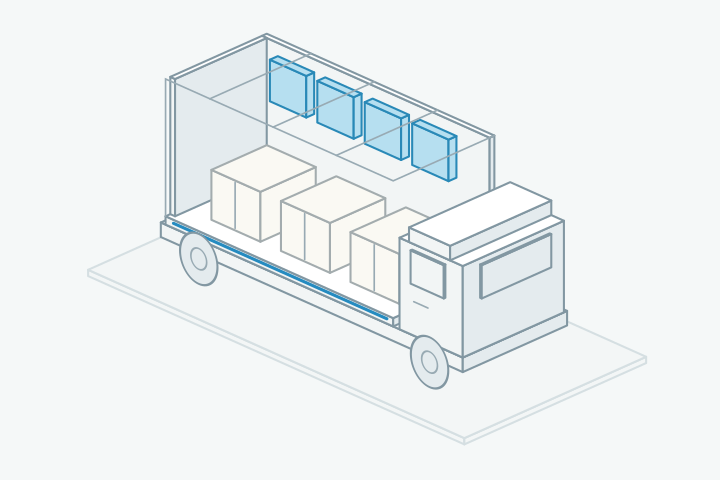
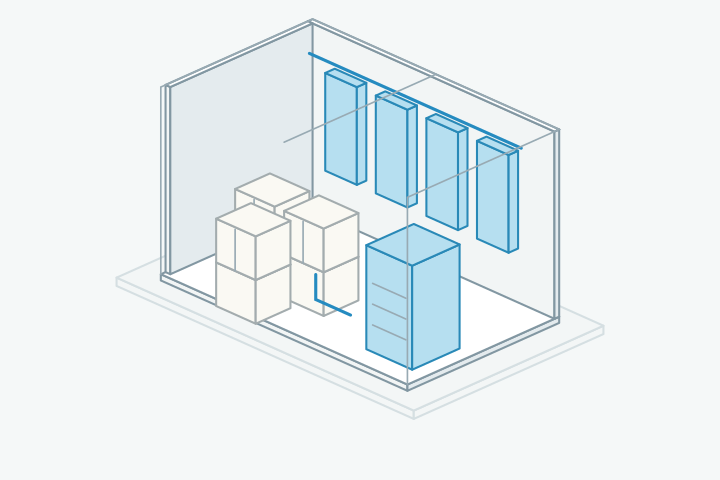
A plug-and-play UltraST PCM cooling-battery built around our material by Solar Tribe. Floor-stacked modules charge during off-peak or PV-surplus windows, then release stored cold during peak tariffs, door-opening disturbances, and outage events.

2.39×
Longer cold
retention vs ice boxes
41.6%
Electricity cost
saving via 8h charge
21.67h
Outage hold
shutdown test
96%
Cycle reduction
45 to 2 per day
0
Refrigeration
line retrofit
01Risk diagnosis
02Measured data
03Product mechanism
04Sizing & fit
05Validation & review
01 / Risk diagnosis

Cold-room losses often happen when the refrigeration plant has no buffer left.

Door-opening peaks, peak tariffs, short outages, and equipment faults all point to the same issue: compressors provide instant cooling, but the room lacks dispatchable cold capacity.

Traditional ice boxes can provide short-term backup, but cold release is uncontrolled, heat transfer is limited, and installation plus turnover can be heavy. Distributed UltraST PCM modules turn cold into planned, dispatchable in-room capacity: charge during low-cost windows, lock cold during low-load periods, and release it on demand during risk events.

So the question is not simply whether to add more cold source. It is whether the room can extend outage hold time, avoid peak-hour compressor duty, reduce start-stop wear, and prove value in one pilot bay without rebuilding the refrigeration system.

Temperature drift pattern

Cold-room temperature response after a cooling interruption — with and without distributed PCM buffer
8°C 6°C 4°C 2°C Room temp. DRIFT UP BUFFERED 00:00 12:00 24:00
Room temperature — no buffer Room temperature with distributed PCM

Illustrative trend only. Actual setpoint window, hold time, and charge-discharge strategy are confirmed from room conditions and pilot data.

Risk 01

Power outage or compressor fault

Once active cooling stops, product temperature can approach its upper limit quickly. Operators need more safe response time.

SolarCool shutdown test: 21.67h vs 9.08h
Risk 02

Peak tariff and demand exposure

Without storage, compressors cycle across peak and off-peak windows, so expensive electricity is consumed reactively.

8h charging strategy: 41.6% cost saving
Risk 03

Short off-peak windows are missed

Slow ice-box systems struggle to fully use short off-peak windows or convert midday PV into usable cold capacity.

2h rapid test: 60 min vs 115 min
Risk 04

Overhead ice-box safety and upkeep

Ceiling suspension, manual pre-cooling, and leakage risk can turn an energy upgrade into a site-safety problem.

Floor-stacked · leak-free · no line retrofit
02 / Measured data

Start with the evidence, then size the system.

The SolarCool Kit story is strongest when cooling speed, outage hold time, temperature recovery rate, compressor starts, and annual electricity cost are put into one decision view.

2.39×

Longer cold retention

Compared with the ice-box baseline, the tested system extended the useful cold buffer.

41.6%

Annual electricity cost saving

Based on an overnight 8h off-peak charging strategy that moves load away from expensive hours.

96%

Fewer compressor starts

Under the tested operating pattern, daily starts fell from 45 to 2, reducing equipment wear.

0.300°C/h

Slower shutdown warming

Cold-lock behavior slowed temperature recovery and bought more operating response time.

— Dimension Traditional ice-box system SolarCool Kit Operating meaning
2h rapid cooling 115 min 60 min faster Better fit for short off-peak windows and PV self-consumption.
Shutdown hold 9.08 h 21.67 h +138.5% More response time during outage or compressor failure.
Temperature recovery 0.837 °C/h 0.300 °C/h lower Slows movement toward product temperature limits.
Daily starts 45 / day 2 / day -96% Reduces short cycling and compressor wear.

Data are from Solar Tribe comparative testing against an ice-box baseline. Actual savings, hold time, and charge-discharge strategy depend on setpoint, room size, door behavior, tariff structure, and heat-transfer conditions, and should be validated in a pilot bay.

03 / Material & System options

From material platform to deployable module.

Two paths serve different users: partners with integration capacity can design their own cooling subsystem around UltraST PCM; cold-room operators seeking a fast pilot can evaluate Solar Tribe’s engineered SolarCool Kit.

— Material option

UltraST PCM + SemiST plates

Specify Passive Edge cold-side chemistries into your own cooling-battery design. Use SemiST PCM plates as the storage element, with chemistry tuned to your room’s setpoint window.

  • PHASE POINTTunable, sub-zero to +10 °C window
  • FORM FACTORPlates · Modules · Custom geometry
  • DELIVERSMaterial + technisches Datenpaket
  • FIT FORRefrigeration integrators with in-house design capacity
— Integration option · via Solar Tribe

SolarCool Kit (UltraST inside)

Pre-engineered distributed cooling-battery modules built by Solar Tribe around our UltraST PCM. Floor-stacked, fast to install, and requiring no refrigeration-line retrofit — measured at 2.39× longer cold retention and 41.6% electricity cost saving under an 8h charging strategy.

  • FORM FACTORModular plug-and-play kit · floor-stacked array
  • PROOF POINTS2.39× retention · 41.6% electricity saving · 21.67h shutdown hold
  • DELIVERSEquipment by Solar Tribe + integration spec + pilot plan
  • FIT FORCold storage operators wanting validated, ready-to-deploy blocks
  • LEARN MOREsolarcool product page ↗
03 · The integration option in detail

SolarCool Kit — from traditional ice boxes to dispatchable cold storage.

SolarCool Kit — modular UltraST PCM cooling battery by Solar Tribe — Product · SolarCool Kit
UltraST PCM · by Solar Tribe PE / 02

SolarCool Kit is a stackable cooling-battery built around our UltraST PCM by downstream partner Solar Tribe. It does not simply replace one cold source with another; it turns charge, cold lock, and release into an operating strategy for peak tariffs, PV self-consumption, outage resilience, and frequent door-opening events.

  • — 01 Fast charge

    Use short off-peak windows

    Fan-assisted heat transfer helps PCM charge during low-price electricity or PV-surplus windows.

  • — 02 Cold lock

    Hold cold until it matters

    After charging, reduced heat exchange limits wasteful release and keeps the buffer available for risk periods.

  • — 03 On-demand release

    Respond to peaks and disturbances

    Stored cold is released during door-opening peaks, temperature rise, or demand-response events to reduce compressor load.

  • — 04 Installation

    Floor-stacked · less site work

    Modules are positioned in the room without changing compressors, ducts, or refrigeration piping.

Phase 01 · Charge

Charge during off-peak or PV hours

When the chiller is running on lower-cost electricity, the module converts that energy into in-room cold capacity. It can support overnight off-peak charging and midday PV self-consumption.

Phase 02 · Lock

Keep the buffer for later

After charging, the module reduces heat exchange so cold is not wasted during low-load periods. The buffer remains available for peak tariffs, outages, or door-opening disturbances.

Phase 03 · Release

Release when the room needs it

When room temperature rises or demand-response events arrive, stored cold helps cover the heat load and lowers compressor response pressure.

— Attribute SolarCool Kit (UltraST inside) Traditional ice boxes / ice plates
Cold retention 2.39× longer ↑ hold time Baseline — melts and drifts
Energy use 41.6% lower ↓ kWh Baseline — heavy compressor duty
Install time Two-person fast stacking · typically <2 h Suspension / pre-cooling / manual turnover
Refrigeration impact Zero modification None — but no buffering benefit
Reusability > 10,000 cycles · formstabil Single-use / short reuse life
Demand-response ready Yes — shifts load off peak No
Operating control Charge · lock · release Passive release after freezing

Proof points are from Solar Tribe field measurement against an ice-box baseline; actual figures are tuned per room setpoint and validated during the pilot bay.

Explore the SolarCool Kit product site ↗ Equipment by Solar Tribe · UltraST inside
— Partnership model · EDGE Material Inside

A micro/nano-encapsulation platform at the core —
co-building a global thermal-buffer ecosystem.

We build the material; partners build the equipment. Cold-room cooling-battery modules like the one shown above are not Passive Edge equipment — they are co-developed with downstream partners under our EDGE Material Inside model: Passive Edge supplies UltraST PCM material and chemistry, while the partner designs, manufactures, certifies, and sells the equipment.

The system you see here is an example: equipment patent and commercial ownership sit with Solar Tribe, who builds the cooling-battery system around our material. We deliberately stay in the material layer — it’s how we let many industries get to a thermal-buffer outcome without anyone competing for the same customer.

If you’re an OEM, system integrator, or refrigeration specialist evaluating cold-storage applications, talk to us about an EDGE Inside partnership — we match end-customer opportunities with the right partner and advance the account together. For products partners build around UltraST PCM, Passive Edge can also support channel representation and project rollout.

For large energy users with clear savings targets, the model can extend into an energy-finance layer: we can help introduce funds, energy performance contracting, or finance leasing so verified energy savings support deployment with lower upfront capital pressure.

— Layer 01

Passive Edge · Material

UltraST PCM, chemistry, encapsulation, technical data package.

— Layer 02

Solar Tribe · Equipment (SolarCool Kit)

System design, equipment patent, manufacturing, certification, sales. View product ↗

— Layer 03

Cold storage operator

End customer: refrigeration warehouse, 3PL, food & beverage facility.

— Layer 04

Finance layer · Funds / contracts / leasing

For high-consumption customers, capital and energy-service mechanisms can let verified savings carry the rollout.

— 01
We don’t build competing equipment.

We stay focused on material, data packages, and technical support rather than competing with partner systems.

— 02
Partners own the system.

Equipment patents, brand, manufacturing, and customer delivery boundaries are led by the partner.

— 03
We develop customers together.

Opportunities are matched with the right partner and advanced jointly; partner products can also be represented through our channel when it helps deployment.

04 / Fit assessment & project inputs

First decide whether the room is worth sizing, then gather the operating data.

SolarCool Kit and UltraST PCM storage are most valuable when the operating pain is clear: tariff spread, PV self-consumption, outage resilience, compressor cycling, or conventional ice-box safety. The clearer the pain, the easier the pilot value is to prove.

— 01 Strong fit

Peak/off-peak spread or PV is meaningful

Night off-peak power, midday PV, or demand-response windows give stored cold a real operating value.

— 02 Strong fit

Outage tolerance is too short

High-value goods or tight temperature limits make extra response time valuable during power or equipment events.

— 03 Needs review

Space or heat-transfer constraints are tight

Available floor/wall area, height, load limits, airflow, and defrost cycles can change the module configuration.

The more of the following you can share early, the faster we can return a useful response. None of these constitute a commitment from either side.

— Room profile
Room volume, setpoint window, average door-opening frequency, pallet turnover, internal heat load.
— Refrigeration system
Compressor count and capacity, refrigerant, evaporator topology, defrost cycle, current cycling behavior.
— Site & constraints
Location, ambient envelope, available floor / wall area, ceiling height, structural load limits, electrical capacity.
— Tariff structure
Energy rate, demand charges, time-of-use windows, peak / off-peak deltas, demand-response program eligibility.
— Target outcome
Outage tolerance window, cycling reduction target, peak-hour energy shift, product spec / temperature ceiling.
— Timeline & stage
New build vs. retrofit. Single pilot room vs. portfolio rollout. Existing refrigeration partners.
05 / 24-hour operation & sizing tool

Turn cheap power during the day into cold that is available when the room needs it.

The value is not just adding a cold source; it is shifting compressor operation around tariffs, PV generation, door-opening peaks, and outage resilience.

22:00

Off-peak charging

The refrigeration plant charges PCM during low-price electricity windows.

06:00

Cold lock

The charged module preserves cold capacity for later risk periods.

08:00

Morning peak stability

Door openings and turnover add heat load; stored cold helps suppress drift.

11:00

PV top-up

If rooftop PV is available, midday generation can become stored cold.

17:00

Peak release

Stored cold offsets compressor load during high-price periods.

Event

Outage buffer

If active cooling stops, PCM buys more time before product temperature is at risk.

06 / Validation & review path

From product selection to volume supply.

We work in clearly-bounded stages. No stage commits the next. Each stage produces a document you can use internally — even if you don't proceed with us.

— 01

Room conditions submitted

You share room profile, refrigeration system, tariff, and target outcome. We return a written fit assessment within ~5 business days.

— 02

Material / system review

Joint review of chemistry, plate geometry, and module configuration for your specific room. Includes a technical data package and integration spec.

— 03

Pilot bay plan

Scoped pilot in a single cold room or bay, with instrumentation, success criteria, and a defined validation window covering cycling and outage scenarios.

— 04

Portfolio validation

Pilot data review and recommendation. Decisions about additional rooms or sites are made on measured evidence.

Muster & TDS anfragen Try the Product Selector
07 / Technical resources

Build your internal case.

Get in touch

Share your room conditions, refrigeration profile, and target outcome.

Our team will respond with a fit assessment, a relevant technical data package, and a proposed pilot test plan if there is a match.