High conductivity: move heat into PCM faster
A continuous three-dimensional graphite network provides heat paths and reduces internal heat-transfer bottlenecks in UltraST.

MATERIAL SCIENCE / PCM
Built on Phase Change Material (PCM), UltraST form-stable composite encapsulation and MOF-catalyzed transient encapsulation connect material performance with application needs.
01 / PHASE CHANGE MATERIAL
A phase change material absorbs latent heat as it melts and releases it as it solidifies, providing repeatable thermal buffering within a selected temperature range. This separates thermal supply and demand in time for cooling, heating and temperature management.
Phase change occurs over a temperature range. Selection considers transition temperature, latent heat, thermal conductivity, supercooling and recovery conditions together.
Heat absorption · melting →
02 / ULTRAST
PCM is confined within the micro- and nanoscale pores of a three-dimensional graphite skeleton. Confinement helps retain crystallization water and salt components and suppress phase separation, while the connected skeleton provides heat-transfer paths for repeated cycling and module integration.
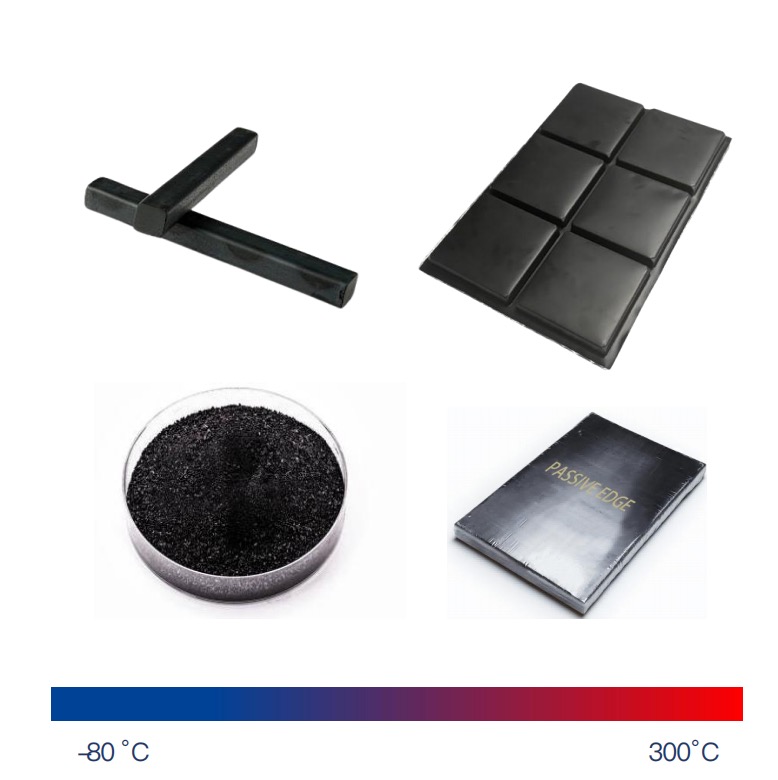
A continuous three-dimensional graphite network provides heat paths and reduces internal heat-transfer bottlenecks in UltraST.
Pore confinement and the composite skeleton hold the PCM core, reducing migration and liquid-leakage pathways after melting.
Flame-retardant selected UltraST formulations work with encapsulation; combustion performance is assessed for the material and finished product.
Latent heat stores energy within the selected transition range; usable capacity follows the effective PCM content of the finished product.
Reduce delayed solidification so the material can store cooling or release solidification heat closer to its intended temperature range.
Confinement limits component migration and phase separation to support thermal performance over repeated charge/discharge cycles.
| Dimension | Salt hydrate PCM without targeted treatment | UltraST design approach |
|---|---|---|
| Structure and form | May flow or migrate when melted | Pore confinement and form-stable integration |
| Cycling stability | Phase separation can reduce latent heat | Suppress separation and improve cycling retention |
| Heat transfer | Conduction can limit charging and discharging | Continuous paths through a 3D graphite skeleton |
| Supercooling | Solidification may be delayed below the transition temperature | Reduce supercooling and improve heat-release response |
Conceptual structure and process, not a measured micrograph or a representation of actual dimensions.
Thermal conductivity, cycle count, latent-heat retention and supercooling depend on formulation, temperature range and test conditions. Refer to the technical data for the selected material.
Explore materials and technical data03 / MICROENCAPSULATION
The platform uses metal–organic frameworks (MOFs) to catalyze transient encapsulation, forming an encapsulating layer around a functional core. Core, shell and particle-size design support the integration of PCM into textiles, coatings, foams and composites.
Match the core chemistry to the target temperature range and functional requirements.
Develop the encapsulating layer, particle-size range and core loading together.
Evaluate dispersion and compatibility against processing and service conditions.
NANOENCAPSULATED PCM / LIQUID COOLING
Nanoencapsulation forms PCM microcapsules; dispersion design keeps them stably suspended. The coolant can transport heat and provide phase-change buffering, alongside an UltraST storage branch.
Design particle size, shell and dispersion together. Assess settling, redispersion and distribution after circulation so microcapsules remain available for heat transport.
The shell confines the PCM core. Evaluate shell integrity and performance retention under pump shear, thermal cycling and contact with equipment materials.
The core absorbs latent heat within its transition range, increasing heat-carrying and buffering capacity there. System improvement also depends on flow, heat exchangers and pump energy.
Conceptual system; interfaces are matched to equipment. Assess added latent capacity separately from system cooling performance, including pressure drop, pump energy, compatibility and circulation stability.
Discuss a collaborationKNOWLEDGE
A Phase Change Material (PCM) absorbs and releases latent heat through a change of phase. It is used for cooling and heating storage and thermal buffering.
UltraST confines PCM within a 3D graphite skeleton, focusing on form stability, heat conduction, cycling stability and reduced supercooling. MOF-catalyzed transient encapsulation creates core–shell microcapsules for integration into different substrates.
Compare the phase-change temperature with the onset of solidification using an agreed test method, recording sample mass, heating and cooling rates and cycling conditions. Assess the result alongside thermal conductivity, latent heat and changes after cycling.
From material performance to system capability.
Phase-change materials matched to your temperatures and operating conditions.
Browse materialsFrom PCM plates and thermal cores to complete storage enclosures.
Explore modules & enclosuresJoint development of core materials, encapsulation and interfaces.
Explore custom developmentStart with a temperature problem, a material need or a collaboration idea. You can get in touch before technical details are known.
Discuss a collaboration