Later means more temperature margin
Cargo first exceeds 6°C
UltraST sample39.6 h
Reference ice pack28.2 h
11.4 h later · about +40%

Products & materials
Encapsulated phase-change storage plates form the building blocks of stacked thermal cores and containerised storage units. Plate design, temperature range and system configuration depend on the model and project.

The plate stores energy, the core brings plates together, and the enclosure houses the integrated system. Choose the level that fits your target temperature and operating conditions.
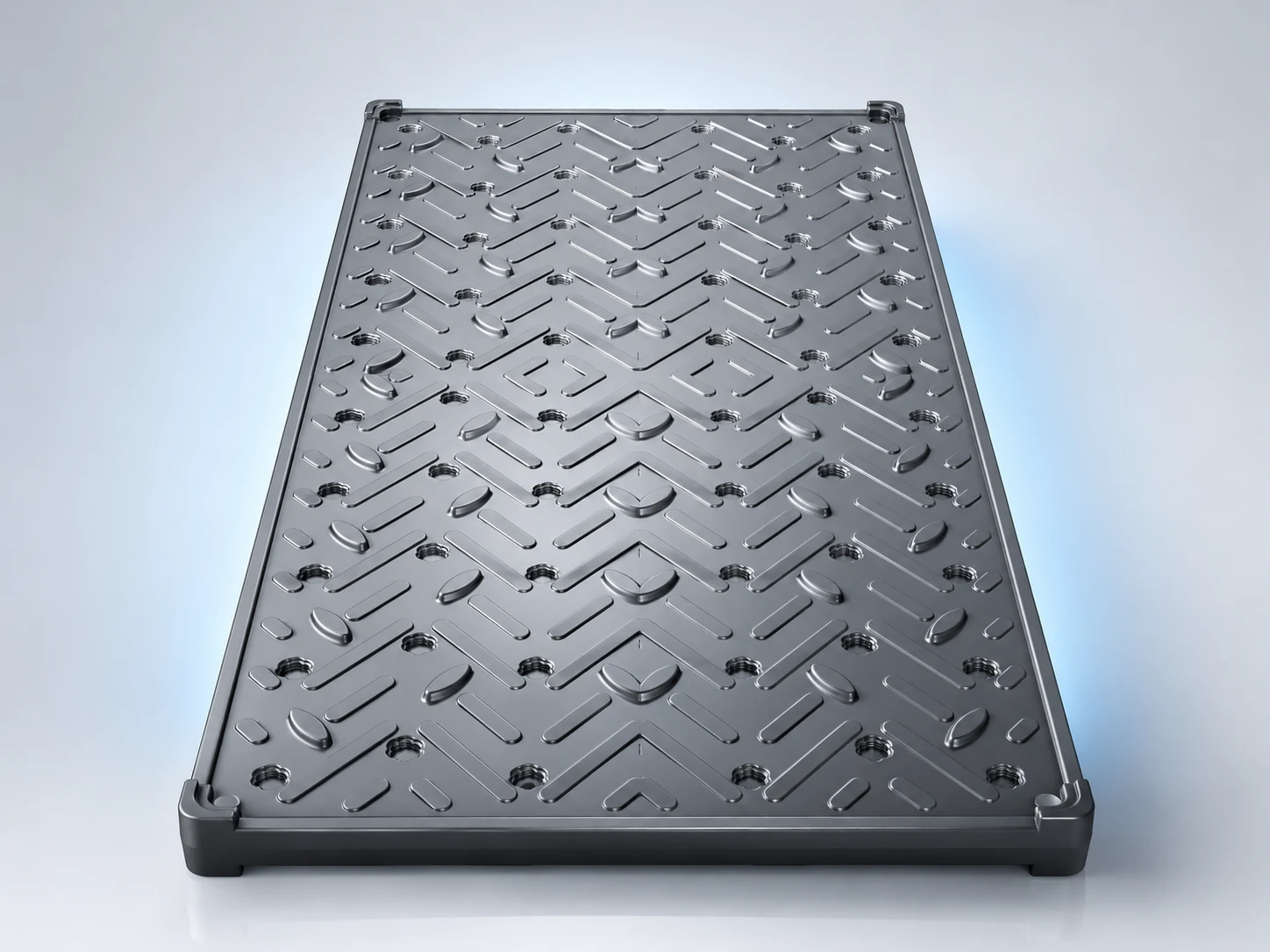
Phase-change material is encapsulated in a plate to store and release cooling or heat within its specified temperature range.
Multiple plates form an array matched to the heat-transfer structure and flow paths.
The core is housed in an enclosure and connected to heat exchange, circulation and control systems for the project.

Cold-chain transport
UltraST combines a conductive composite network, shape stability and latent heat: heat reaches the material faster, cooling fits within limited packaging space, and liquid leakage paths are reduced. High-enthalpy, low-supercooling material selection matches storage capacity and conditioning temperature; validate heat transfer in the actual box, pallet shipper or vehicle.
One test. Two samples, side by side.
Later means more temperature margin
11.4 h later · about +40%
Less time means faster initial cooling
16.2 min less waiting · about −61%
Both sets contain 3.21 kg net PCM
Mass −4.4% · volume −8.8%
Source: 5°C cold-chain PCM comparison report, March 2026, pp. 5, 8 and 9. Ambient 12°C; 45 L insulated boxes; three plates and 3.21 kg PCM per set; cargo probe inside a water bottle. 6°C is this comparison's threshold, not a universal compliance limit. Results apply to the tested samples and conditions, not every T3/T5 variant or transport route.
Solid-state PCM standard plates for ceiling cavities, window-side cabinets, and interior assemblies, reducing daily temperature swings and improving indoor comfort.
300 × 300 mm · T3 30 / T5 50 mm · six phase-change temperatures, 22–32 °C · 0.154–0.257 kWh/plate

5–32 °C, for chilled-water buffering, peak shifting, and cooling-loop stabilization.
| Phase-change temperature | Chemistry | Request |
|---|---|---|
| 5 °C | 0.281-0.397 kWh | Email request |
| 7 °C | 0.274-0.434 kWh | Email request |
| 10 °C | 0.261-0.460 kWh | Email request |
| 12 °C | 0.274 kWh | Email request |
| 15 °C | 0.274-0.493 kWh | Email request |
| 17 °C | 0.274 kWh | Email request |
| 18 °C | 0.289-0.483 kWh | Email request |
| 20 °C | 0.279-0.500 kWh | Email request |
| 21 °C | 0.279 kWh | Email request |
| 22 °C | 0.263-0.403 kWh | Email request |
| 23 °C | 0.286 kWh | Email request |
| 24 °C | 0.286-0.556 kWh | Email request |
| 25 °C | 0.286 kWh | Email request |
| 26 °C | 0.286-0.559 kWh | Email request |
| 27 °C | 0.286 kWh | Email request |
| 28 °C | 0.286 kWh | Email request |
| 30 °C | 0.251-0.561 kWh | Email request |
| 32 °C | 0.247 kWh | Email request |
Negative phase-change temperatures, for LNG cold-source recovery and low-temperature process buffering.
| Phase-change temperature | Chemistry | Request |
|---|---|---|
| −39 °C | 0.535 kWh | Email request |
| −24 °C | 0.400 kWh | Email request |
| −21 °C | 0.495 kWh | Email request |
| −19 °C | 0.416 kWh | Email request |
| −15 °C | 0.394 kWh | Email request |
| −10 °C | 0.408 kWh | Email request |
| −5 °C | 0.435 kWh | Email request |
Published phase-change temperatures for heating, waste-heat recovery, and process thermal management.
| Phase-change temperature | Chemistry | Request |
|---|---|---|
| 49 °C | 0.255 kWh | Email request |
| 58 °C | 0.521 kWh | Email request |
| 61 °C | 0.254 kWh | Email request |
This page summarizes published material and module data. Entries marked for technical confirmation require further review; use the relevant product data sheet and project confirmation for final selection. Request product manuals by email. Edge Comfort documents are available to download directly.
Series-level S-type cooling cabin manuals covering all published 5-32 °C PE-DC-CS phase-change temperatures, with capacity, water sensible energy, and discharge power calculated on one unified S-type basis.
PE-DC-CS-S SERIES · 18 phase-change temperatures, 5-32 °C · 347-680 kWh · up to 2.34 MW · S-type 2.8 × 2.3 × 2.3 m

Start with a temperature problem, a material need or a collaboration idea. You can get in touch before technical details are known.
Discuss a collaboration